November 15-18, 2025 | Parrington Hall & Seabeck Conference Center
Cohosted by The Ohio State University’s John Glenn College of Public Affairs & University of Washington’s Evans School of Public Policy & Governance
Overview of the Workshop
Historically, public universities have played a foundational role in the civic life of their communities. Yet, the erosion of trust in higher education has called into question the value of public universities in service to their communities. To rebuild trust, we must demonstrate and deliver more value to our state and local community partners. Public Affairs and Public Policy Schools at R1 public institutions are uniquely equipped to lead the way in defining, enabling, delivering and documenting public impact.
The Public Impact Accelerator was designed to bring together a coalition of scholars, deans, practitioners, and institutional leaders committed to reimagining a future of research that is rigorous, relevant, and capable of producing real public impact.
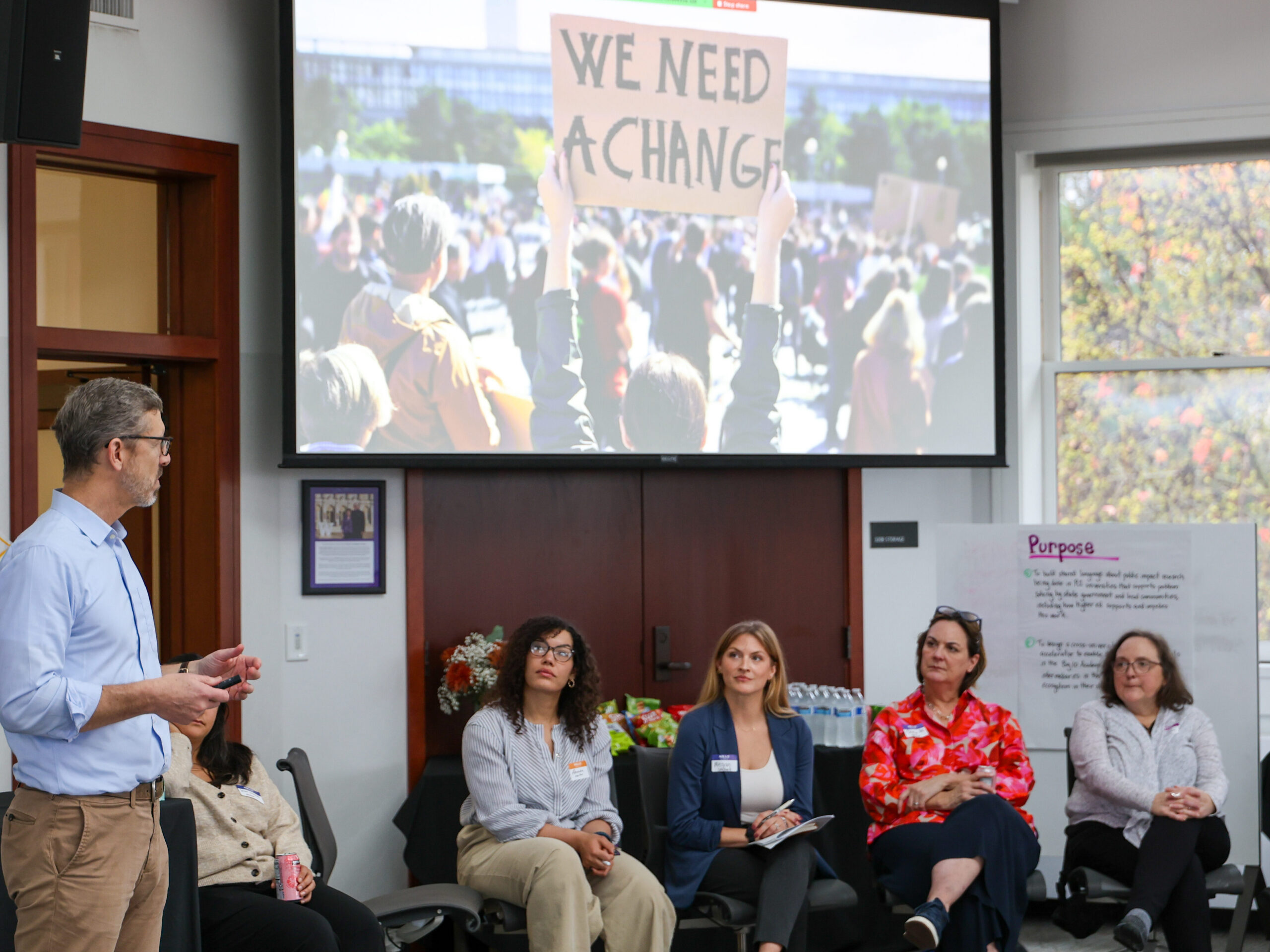
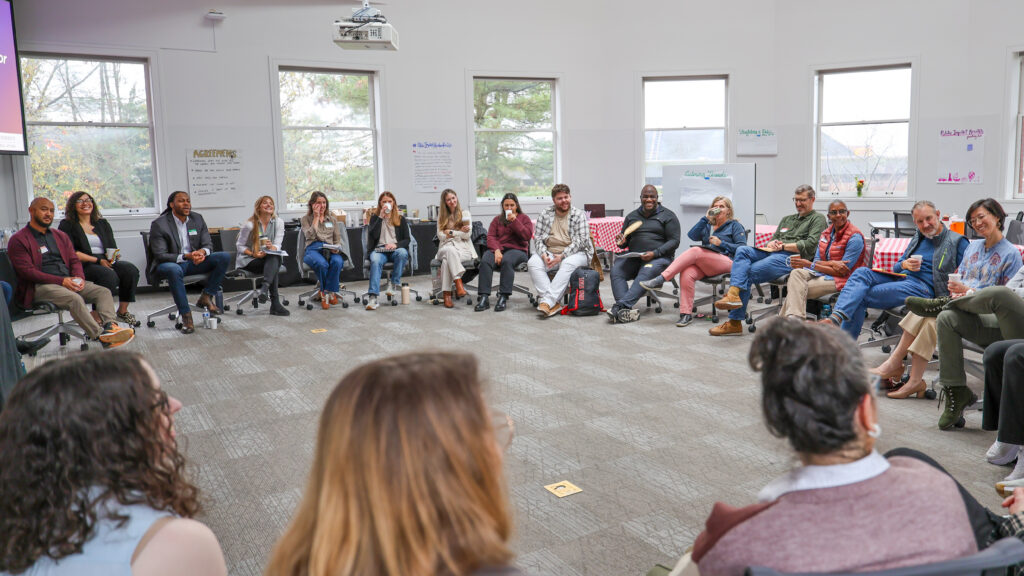
Over four days, we convened a community of scholars from major public universities—a coalition of the willing. We listened to stories and engaged in conversations around what is needed to activate scholars’ capacity and develop a strong network of public affairs scholars across peer R1 public institutions – the Public Impact Accelerator.
The Accelerator created a space for listening, reflection, design, and imagination. We hope this newsletter brings back the energy of your conversations and the momentum of our shared learning.
Scholar Stories of Public Impact Research
Powerful stories influence action. When we tell stories, we humanize issues in ways that deepen understanding, weaving together elements of both heart and head.
To ground ourselves in lived experience, we began with Collective Story Harvest. Through this participatory engagement method, participants shared personal narratives about how they came to this work, how they navigate institutional realities, and what it means to be a scholar committed to public impact. As stories were told across Saturday and Sunday, participants documented thoughts based on the following listening thread categories:
- Definition of Public Impact Research
- Storyteller’s Identity
- Institutional Setting
- Place
- Design & Inquiry
- Adjustments
- Value
- Institutional Support
Across stories, public impact scholars reflected on the complexity of being part scholar, part citizen, part analyst, part collaborator. Many shared the feeling of working in a space between worlds—where rigorous inquiry meets lived experience, and where personal commitments often seem in conflict with professional expectations.
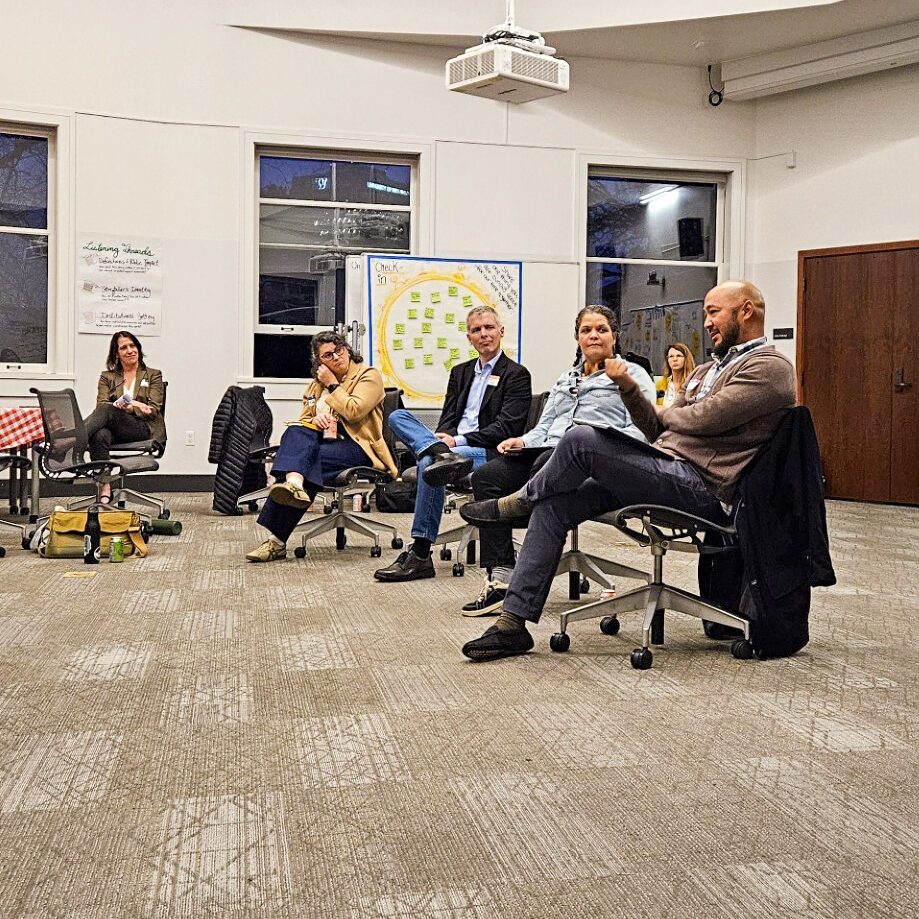
“[As a public impact scholar] You have to do what matters, but also what satisfies [institutional requirements]”
Participants openly acknowledged the pressures of tenure and concern they inherited that public impact work may jeopardize early-career trajectories. They also discussed the difficulty of managing competing interests and recognized that universities can both be an asset or a liability, depending on the audience and the context.
Despite these challenges, participants expressed pride, clarity, and determination. Many noted that tenure, once secured, becomes a powerful platform for shifting institutional norms. They also emphasized the importance of mentoring and creating pathways for younger scholars to step into public impact research. Across stories, a common thread emerged: relationships—with communities, agencies, and colleagues—are an essential infrastructure of this work.
Deans Share Perspectives
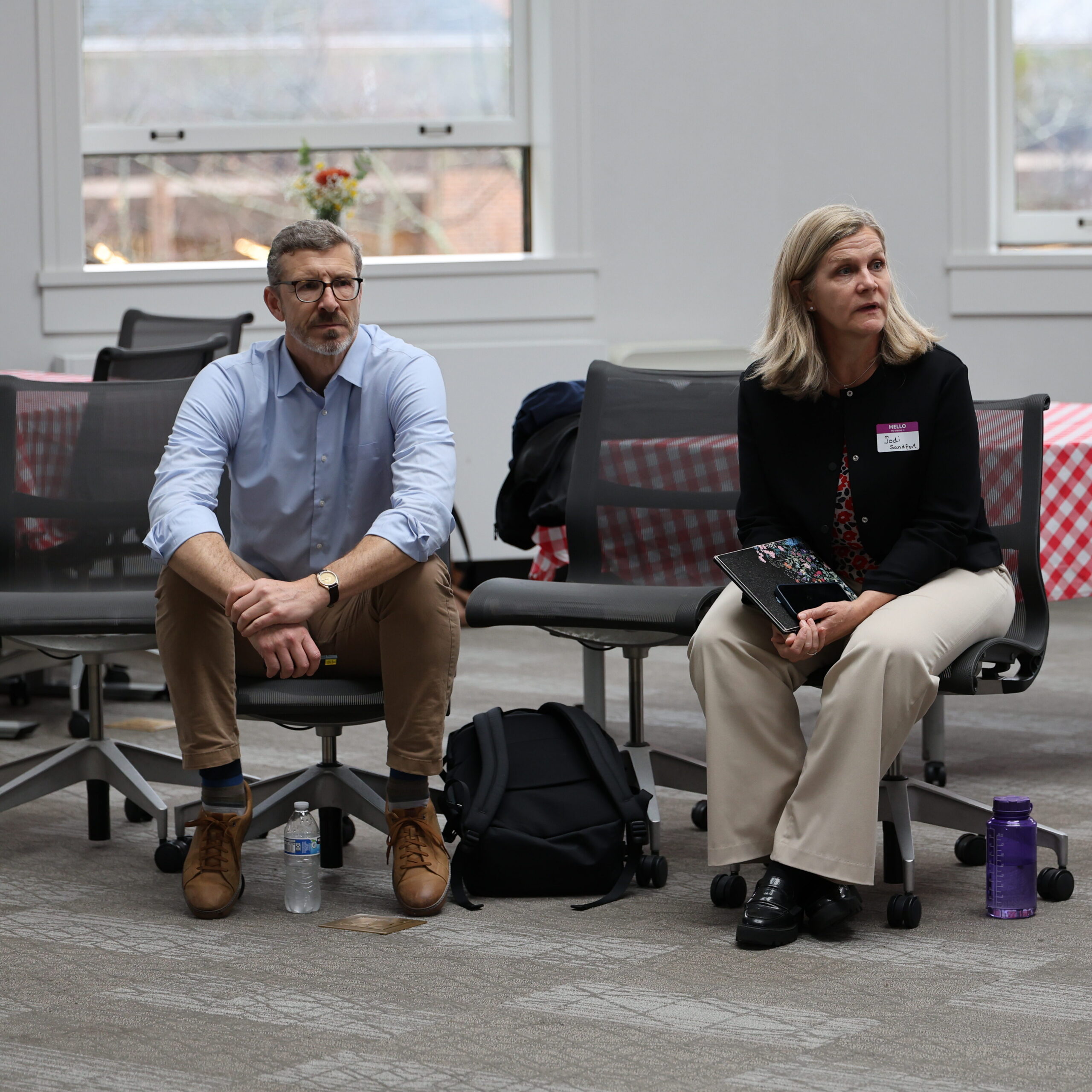
After Collective Story Harvest concluded Sunday afternoon, four deans shared reflections on the role their institutions play in supporting Public Impact Research (PIR). Their comments revealed both enthusiasm and candid realism.
Patterns emerged across institutions. All of the deans underscored the importance of faculty recognition, durable organizational structures, and a collaborative approach to supporting Public Impact Research. They also shared a common concern about how to measure impact—and how to make it visible within assessment systems that often privilege bibliographic measures of scholarship. Yet the level of existing infrastructure varied considerably, signaling different institutional baselines for this work. Even so, there was unanimous agreement that now is the right time to move forward collectively.
After an engaging workshop at Parrington Hall in Seattle, participants transitioned to the serene Hood Canal at Seabeck, Washington. The change of setting provided space for deeper connection and informal dialogue, allowing ideas from the day’s sessions to evolve in a more relaxed environment.
Designing a Collaborative Network

As we settled into Seabeck Conference Center, participants reflected on the learnings from Collective Story Harvest and individual reflection to generate discussion topics around forming a collaborative network with current funding and resources across institutions:
- Training & Mentoring
- Recognition & Rewards
- Showcasing and measuring the use of research to achieve public impact
Working together on a common ‘moonshot problem was added as an additional category as we moved onto imagining a collaborative network with significant funding in place.
These sessions produced rich documentation that will be used to generate strategies and plans. The detailed questions, concepts, tensions, and ideas surfaced in each group are now being woven into a whole.
Key Takeaways
Across topics, people leaned toward capacity-building, shared language, durability, and clarity of purpose.
Designing a Network Structure
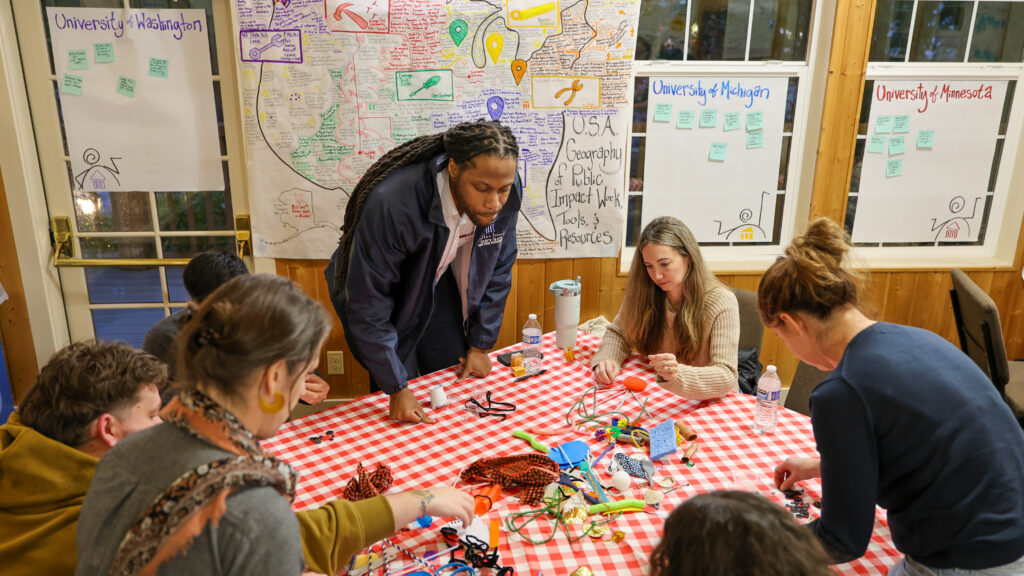
After an afternoon of network design discussions, participants translated their ideas into three-dimensional models using a sensory, story-based method for illuminating complex systems.
In just five minutes, three distinct patterns emerged: a Tiered Model organized around individuals, institutions, and a shared network; a Reciprocity Model marked by multi-directional flows between universities and publics; and a Hub-and-Spoke Model with rotating leadership and a central coordinating team.
Across all three, participants emphasized the need for practitioner and community representation, flexible governance, and designs that complement rather than compete with existing centers. Concerns about funding-levels emerged and there was an expressed interest in rotating or time-bound structures that keep public impact at the core.
“This [collaborative network] is about changing the way we fundamentally do things”
What is Public Impact Research?
As the day came to an end, the group turned toward refining our definition of Public Impact Research. Drawing on the Moulton–Sandfort concept paper and the collective insights of the workshop, participants began shaping a working definition that centers the use of research and the outcomes it produces for the public. The conversation surfaced both clarity and productive tension—questions about rigor and relevance, value and process, and who ultimately defines impact. Participants emphasized that PIR must make conscious use of public resources, uphold high standards, and meaningfully engage communities in shaping the inquiry, not simply the solutions. This working definition will continue to evolve as the network forms, offering a shared foundation for the work ahead.
“This is not a moment – it’s a movement.” – Lin Manuel-Miranda,
Hamilton