


The Public Impact Research (PIR) Network is built on the idea that universities can accomplish more together when it comes to addressing public problems. In an era when trust in higher education is under pressure and societal challenges are increasingly complex, research that directly benefits communities is more important than ever. Yet this work is often dispersed across institutions and not systematically supported or shared. The Network provides a structure for universities to learn from one another and build stronger systems for producing research that creates public value.
The Network connects scholars, students, and institutional leaders across universities to share tools, training models, and lessons learned about conducting research that addresses real public problems. Moving beyond siloed institution and competing for funds, participating institutions collaborate in a shared knowledge commons that lowers the cost and increases the effectiveness of public impact work. Through joint learning, collaborative problem-solving, and shared infrastructure, the Network helps make public impact research more visible, learnable, and sustainable across universities.
Defining Public Impact Research
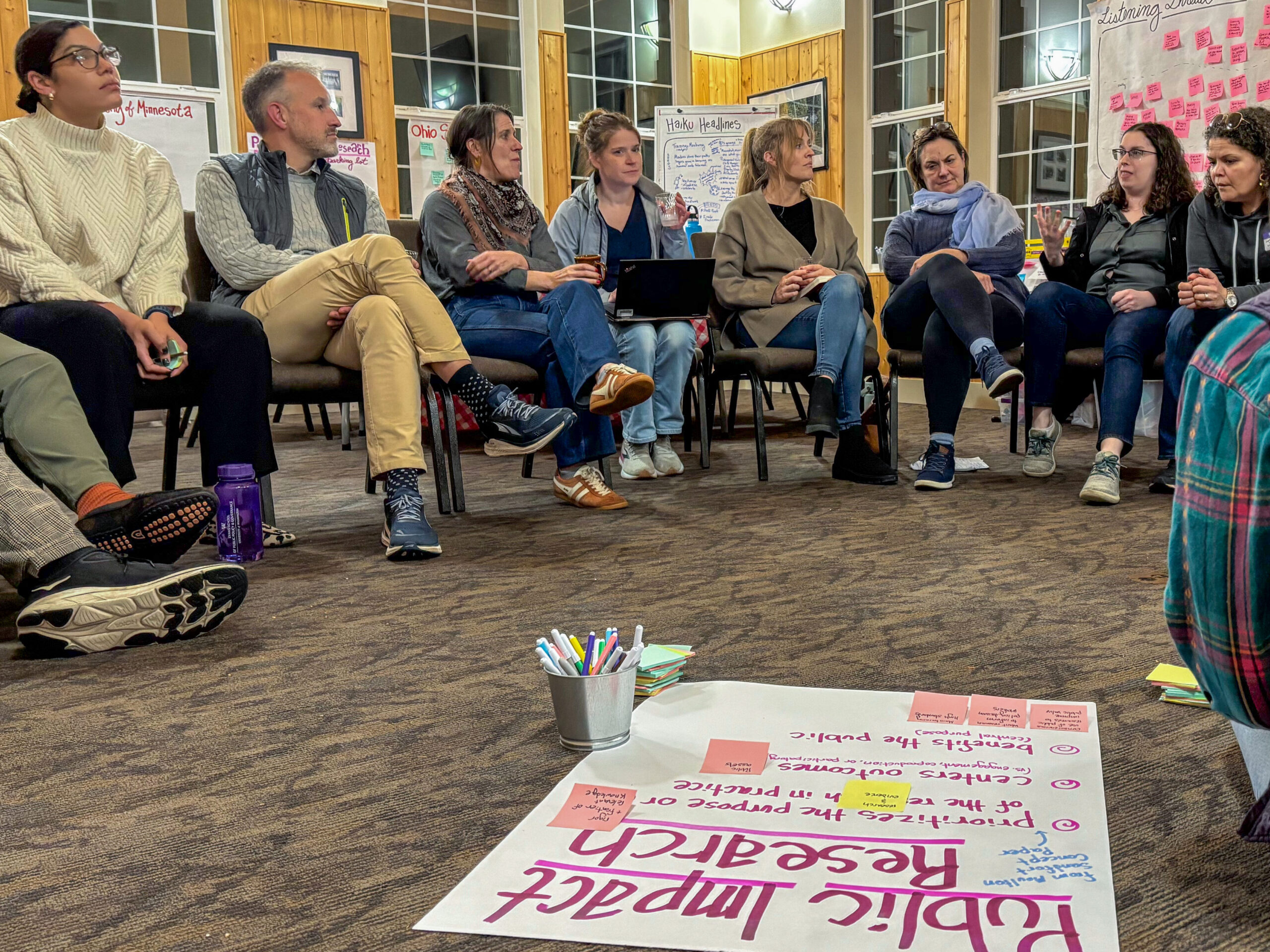
Public impact research addresses a societal problem and creates public value. Framing a problem, filling an evidence gap, or providing legitimacy for solutions are all ways that research can create public value. The Public Impact Research Accelerator (PIR Accelerator) is specifically focused on the local component of public impact– accelerating research that benefits the people and communities surrounding our universities at the state and local levels. The PIR accelerator is based on the premise that university research is more likely to create public value when it is intentionally designed with an in-depth understanding of people and place. This work is grounded by a fundamental commitment to helping everyday people – program operators, nonprofit and public managers, community leaders, state policymakers – make progress on a problem at hand. Beyond immediate problem-solving, it is anchored in enhancing public values and strengthening society’s collective capacity to understand complex challenges, deliberate about shared futures, and act together.
There is no singular approach to conducting public impact research; rather, there are core principles that guide public impact research:
- Addresses important societal problems
- Reflects in-depth understanding of context
- Employs appropriate methods of inquiry
- Demonstrates integrity and respect
- Generates actionable knowledge and resources
- Creates public value
Schools of public affairs at public research universities are uniquely equipped to lead this type of public impact given: (1) our expertise in public programs, policies, and public and nonprofit governance; (2) our understanding of state and local capacity and infrastructure, ranging from human resource systems to administrative data systems; (3) the essential roles we already play in our states’ ecosystems—our students and alumni are the very practitioners and policymakers that stand to benefit from university research at the state and local levels; and (4) our field’s longstanding emphasis on defining, safeguarding, and creating public value.
The PIR Accelerator is a time-limited initiative to build capacity and shift the institutional landscape for public impact research within and across public research universities, amplifying the role for schools and scholars of public affairs in this moment. The PIR Accelerator is structured as a knowledge commons — pooling, collating, and disseminating tools and resources to learn, share, build, fund, and recognize public impact research within and across universities.
Membership Levels
The PIR Network is structured as a knowledge commons that requires investment from and provides benefits to its members. In 2026, participating R1 public universities may engage at one of three levels, reflecting differential investments and benefits.
A Memoranda of Understanding (MOU) will be signed annually between the Universities and Coordinating Council. If creating value to participating institutions, the Accelerator will exist for ten years and require annual investments from its members who receive our shared benefits.
General Membership
This level of membership is relevant to public affairs schools who want to have a formal connection with the Accelerator. It requires a modest financial contribution to cover shared expenses and a staff member or faculty participant in at least one workgroup. The benefits are resources that help support cultural change at the university through access to faculty support and resources.
Strategic Partners
This level of membership is relevant for public affairs schools positioned to help lead the centering of public impact research as a core competency of the field. It requires a slightly larger financial contribution ($7,500 to cover shared expenses and dedicate faculty time (equivalent to one course release) to participate on in network activities. Strategic partners enjoy the same benefits as General Members but also receive additional investments in capacity building for their faculty and visibility for their field-wide leadership.
Core Innovators
This level of membership is relevant for public affairs schools positioned to lead their universities in building capacity for public impact research across their campuses, in addition to leading the acceleration of public impact research nationally. It requires the a larger financial commitment to the network ($12,500) and operation of a PIR Hub to expand the university’s capacity in their state and locality. Core Innovators also have dedicated faculty and senior administrator time (equivalent to two course releases) to lead key workgroups or strategic activities and participate on the Coordinating Council, and benefit from and shape all activities and resources of the network.
Coordinating Council
The Network is governed by a Coordinating Council of faculty and senior leaders from public affairs schools who have joined at the Strategic Partner and Core Innovator member levels. The Council sets collective strategy and priorities, reviews and approves operational activities, makes decisions about financial investments, supports stainable staffing and funding, and evaluates the annual performance of the network.
Coordinating Council Members

Distinguished Scholar
Evans School of Public Policy & Governance, University of Washington

Professor
John Glenn College of Public Affairs, The Ohio State University

Professor
La Follette School of Public Affairs, University of Wisconsin-Madison

Professor
Martin School of Public Policy and Administration, University of Kentucky

Associate Dean for Faculty
Professor
Hubert H. Humphrey School of Public Affairs, University of Minnesota

Director of Possibility Lab,
Professor
Goldman School of Public Policy, University of California Berkeley

Incoming Acting Dean
Professor
John Glenn Collage of Public Affairs, The Ohio State University

Director
School of Public Policy, Penn State

Dean
Professor
Evans School of Public Policy & Governance, University of Washington

Associate Dean for Research
Professor
Evans School of Public Policy & Governance, University of Washington

Director of IU Public Policy Institute
Professor
School of Public and Environmental Affairs, Indiana University