From knowledge to public impact: Three days together in Columbus
The Inaugural Public Impact Research Workshop and Training Institute
September 11 to 13, 2026 | John Glenn College of Public Affairs, The Ohio State University
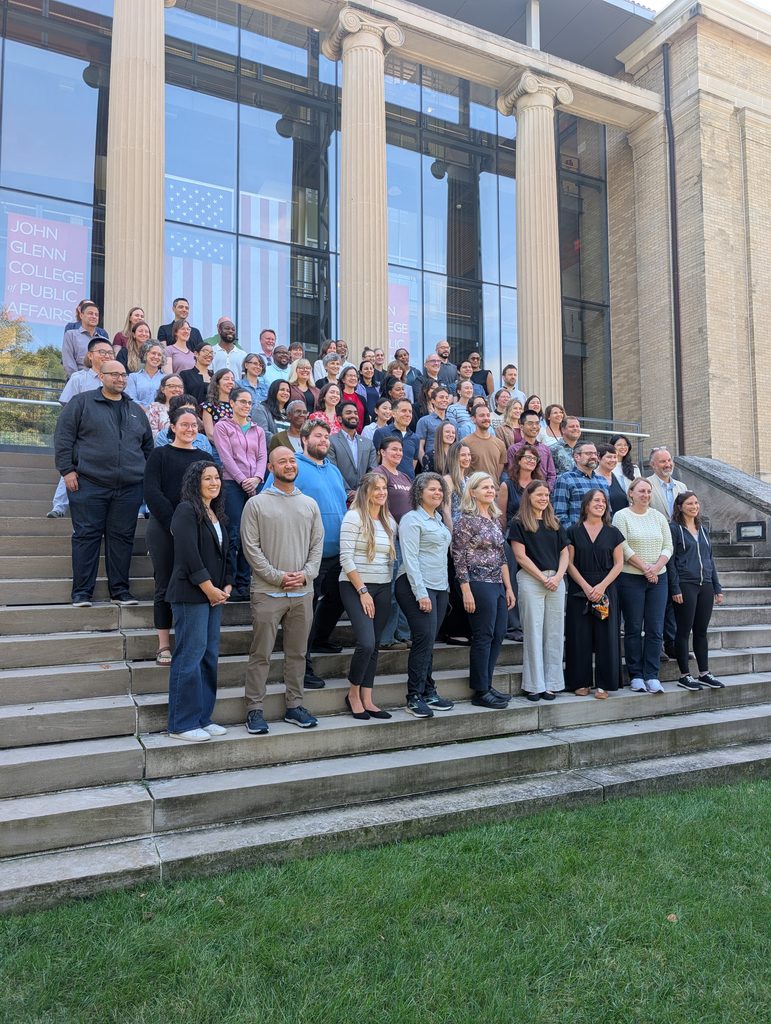
Public impact scholars came together in Columbus: 46 Fellows, 7 Emerging Fellows, 12 General Member scholars, Coordinating Council members, deans and academic leaders, affiliate scholars and funders, and a hosting team, representing fifteen partner institutions and institutional friends. We came with three purposes:
- to launch the inaugural Public Impact Research Workshop and Training Institute;
- to build community and momentum for change;
- and to advance the work of the network.
Trailblazers shared stories about their work and we analyzed common threads and themes. We trained in the practice, from engaging in scenarios where PIR scholars navigated tensions in their work to attending sessions. On the last morning, we built our own agenda with open space technology. This newsletter is an artifact of our time together: a reminder of what we covered and of what comes next. More to come in the conference proceedings.
Friday: Three stories, three threads.
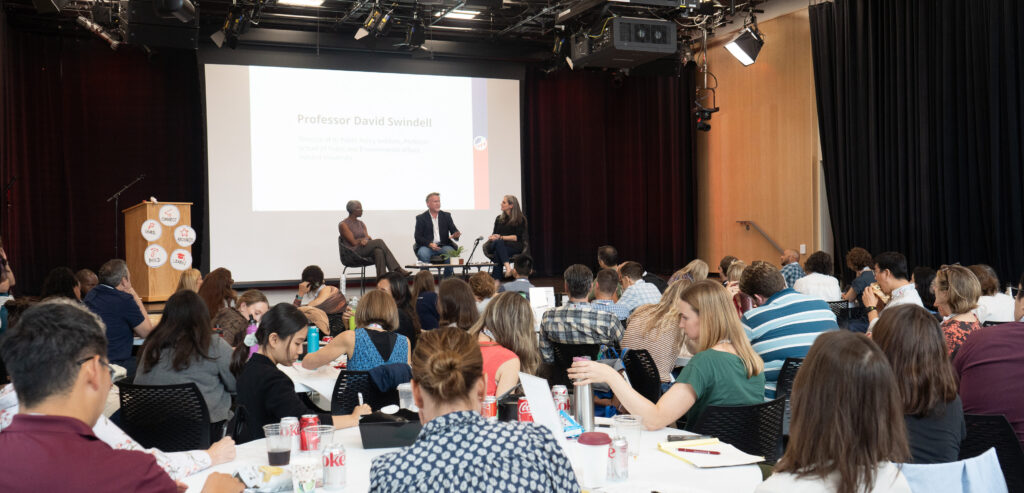
We began at the WOSU studio, where Jodi Sandfort and Stephanie Moulton opened with the need and purpose of this new network and our collective responsibility to share knowledge to help us grow it. It is here that we first heard their definition of public impact research, that we would work with and continue to shape all weekend: “At the community
level, we define public impact research as systematic inquiry, intentionally designed and responsively deployed, to create consequential changes in understanding, capacity, practices or societal conditions that advance public value.”
Then came the trailblazers. Amy Lerman traced a path from research and reflection inside the prison system to a case for civic infrastructure. David Swindell told us about refusing to let rigorous work sit unused, and about building research with the people who make decisions on the ground. Crystal Hall told us about producing evidence for equity at speed: fourteen cities and counties, in the middle of a pandemic, asking how to distribute relief funds fairly. Each story was harvested live in the room.
“Instead of making research fill a gap in the literature, make it fill a gap in the community.” David Swindell
Each of us listened with an assignment. A third of the room tracked definitions of public impact, a third the storytellers’ identities, and a third the institutional settings that helped and hindered their work. Twenty-one small groups then filled structured sheets with themes, implications for research design, and the beginnings of a shared catalogue of
challenges.
The groups converged a lot. The definitions groups interrogated the definition itself, proposing “implemented” over “deployed” and asking whether public impact research is defined by intention or by use. The identity groups found the same profile in three very different careers: the reluctant academic, a learner over an expert, someone who, in one
sheet’s words, breaks the mold to find a career rather than letting the career mold them. The institutional groups heard universities working both ways at once, affiliation granting credibility and inviting mistrust, freedom for the work without the money for it, and two groups wrote LUCK in capital letters. Across all three threads, the challenges list considered incentives and the tenure clock.
Saturday: Learning the practice.
On Saturday, we moved to Page Hall to roll up our sleeves and get to work. Stephanie Moulton and Megan Hasting shared about John Glenn’s legacy and his commitment to public service, in his own words:
“We are more fulfilled when we are committed to something bigger than ourselves.” John Glenn
After describing some of John Glenn’s artifacts and memorabilia on display in Page Hall, participants were asked to discuss in pairs: What would be in your museum/archive?
Jill Clark put real and challenging partnership scenarios in front of us, discussed with the people who lived them. The guidance we built together was practical: understanding where a partner’s ‘no’ comes from, bridge the difference between intent and impact, build a pre-mortem into the design, and know where your own line in the sand is. As one
group’s harvest put it, the data don’t speak for themselves.
Jodi and Stephanie then gave the afternoon its intellectual frame: public impact research as pragmatic inquiry, organized around five practices we harvested live: learning context, defining problems, designing inquiry to purpose, creating actionable knowledge, and upholding ethical standards.
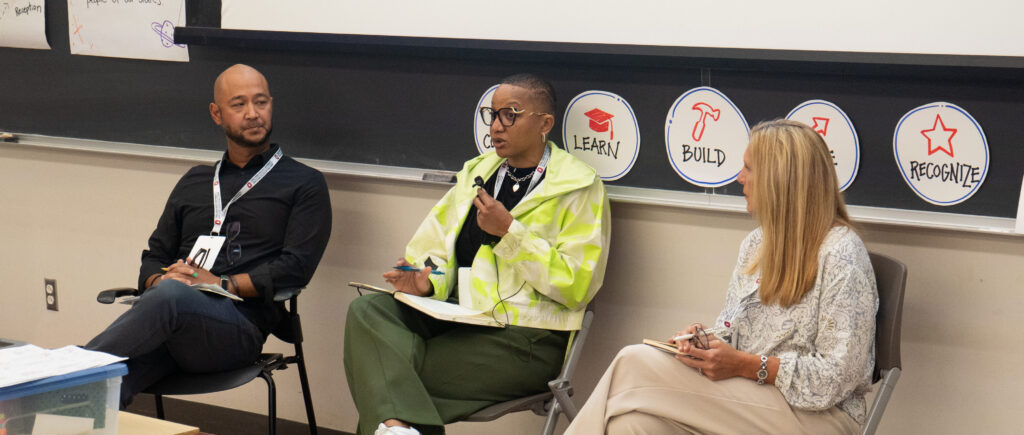
Eight concurrent sessions filled the afternoon. Amy Lerman on moving from informal agreements to formal contracts. Victor St. John, David Suárez, Stephanie Moulton, and Carolyn Hill on academic altmetrics and awards. Michael Collins on communicating PIR in academia. David Swindell on design considerations and the Research-to-Impact Pathway.
Jill Clark, Long Tran, and Stephanie Casey-Pierce on landing in a new research context. Amanda Bankston on bridging worlds with practitioners, communities, and the public. Heather Hill on capturing this work in your professional documents. Jessika Gill and Julianne Slate Weaver on assembling a communications toolkit. Alongside them, the Share,
Hubs, Recognize, Studio, and Communications workgroups met and welcomed new participants into the fold.
The day closed with the whole harvest hung as a gallery walk, a reception with the Glenn College’s own DJ, Ethan Rivera, and space for fellowship, followed by a watch party as Ohio State kicked off against Texas. We won’t report the game results here.
Sunday: You set the agenda.
Open Space works on a simple premise: the people in the room know what most needs discussing. Jodi framed the day against the network’s mission, Megan Hasting explained the process and opened the marketplace for ideas. Two rounds, fifteen documented sessions, and every group filed its own record of who came, what they discussed, and what happens next.
The sessions left behind drafts, decisions, and standing groups. A definitions group proposed a new working definition and offered that having public impact is not the same as doing public impact research. A promotion and tenure group drafted language for deans and external reviewers to review public impact scholars to be discussed at the national deans and directors meeting on September 30. A data stacking group arrived with a written proposal for mapping the network’s placebased research and staffing a curator to connect us. Other sessions launched work on state administrative data, hub building, creative funding, a PIR Conversations series, PhD training, capstone coordination,
and research communities on housing stability, education and workforce development, rural communities, and how our identities shape this work.
Jodi and Stephanie closed us out on the theme that ran through the whole design: reciprocity. Folks signed up for tasks that came out of the open space discussions.
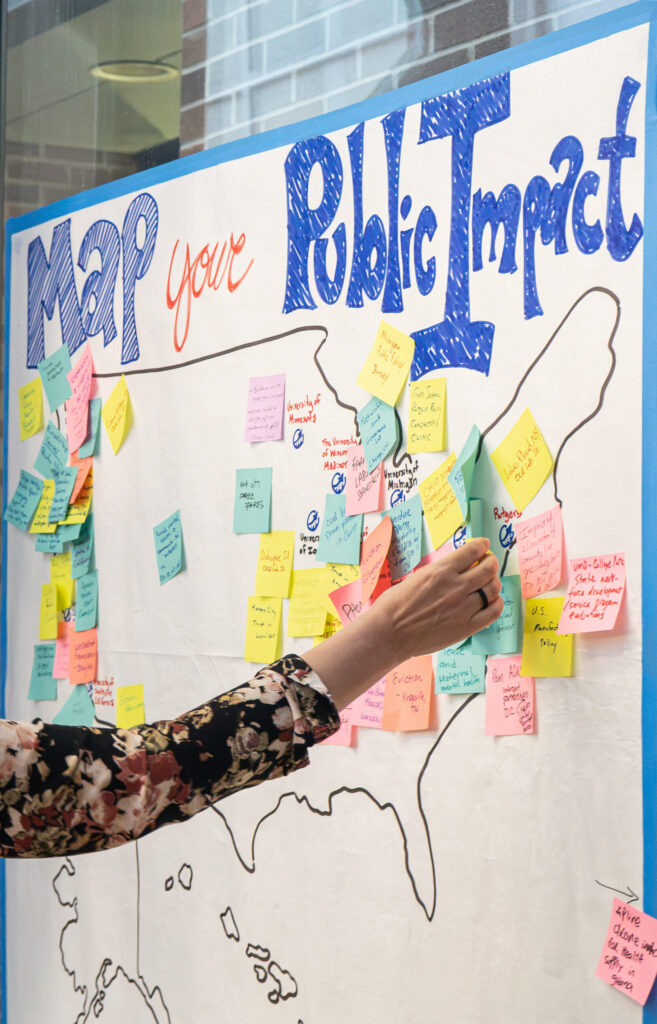
The map of our fifteen institutions stood in the room all weekend, and by Sunday it was covered with your notes marking where you are doing public impact research across the country.
What happens next
- – September 30. Jodi and Stephanie convene the Deans and Directors of member institutions at NASPAA to brief them about what we accomplished.
- – Mid-October. The full workshop proceedings arrive, including every Open Space record and the listening thread synthesis.
- – End of October. The capstone group’s standardized client survey; shared tools and a project library are already moving; the Coordinating Council will share more about their efforts to secure initial philanthropic investments.
- – November 6, noon, at APPAM. The housing stability group reconvenes.
- – By end of year. The PIR Hub scoping survey and a working definition of what a Hub is; the PhD workgroup takes shape; the PIR Conversations series goes to Training and Development.
- – Ongoing. Workgroups pick up the Open Space commitments; the network newsletter will carry progress as it happens.
Thank you
To our trailblazers, Amy Lerman, David Swindell, and Crystal Hall, for the candor and generosity of their stories, and to
every session lead and workgroup convener. To AnnaBell Andrews and the Ohio State events team, who kept three
buildings, the shuttles, and the catering running smoothly all weekend, and to volunteers Christina Dressel and Madeleine Drost, who harvested beside us. To the Glenn College for the welcome, and to WOSU for the studio and the recording.
The workshop was designed and hosted by Julia Carboni, Jill Clark, Jessika Gill, Theresa Harrington, Megan Hasting, Katherine Klausing, Stephanie Moulton, Jodi Sandfort, and Julianne Slate Weaver.
Finally, thank you for everything you wrote on the sheets, the posters, and the map. This newsletter only collects it.
We will see many of you at APPAM, at NASPAA, and in the workgroups this fall.
← Back to News